


Authentication bypass via OAuth implicit flow is one of the most commonly reported OAuth 2.0 vulnerabilities, and it shows up again and again in bug bounty programs and PortSwigger Web Security Academy labs. It happens when a client application trusts data that the browser sends back during login instead of verifying it against the access token itself, letting an attacker log in as any user just by changing a few request parameters.
This article explains what the OAuth Google implicit grant type is, how the authentication bypass works in practice, how to detect it during testing, and the concrete mitigation steps that close the hole, with a PortSwigger lab walkthrough as a case study.
What Is Authentication Bypass via OAuth Implicit Flow
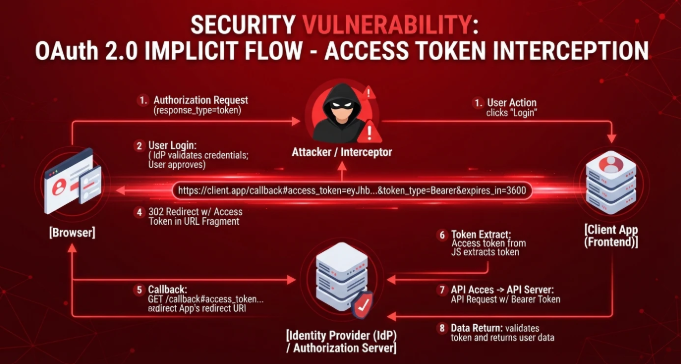
The OAuth 2.0 implicit grant is a flow originally designed for browser-based apps that can’t securely store an OAuth client secret. Instead of exchanging an authorization code for a token on the back end, the identity provider sends the access OAuth token straight back to the browser as a URL fragment, for example:
https://client-app.com/oauth-callback#access_token=6WCCPFA1jHBaL0Qc7RnLhmK8Zv0J8ghNUB3Vaj6V3VW&expires_in=3600&token_type=Bearer&scope=openid%20profile%20email
The client-side JavaScript pulls the token out of that fragment and then calls the identity provider’s `/userinfo` or `/me` endpoint to fetch the logged-in user’s profile data, which it uses to log the user into its own application.
The vulnerability appears when the client application’s back end receives this profile data (email, username, token) from the browser and trusts it blindly, rather than independently re-validating that the token actually belongs to the user it claims to represent. Since the browser, and therefore the attacker, fully controls this request, swapping out the email or username field is enough to authenticate as someone else entirely.
Hire an OAuth Security Specialist!
Specializing in testing OAuth 2.0 and OpenID Connect implementations for implicit flow weaknesses, token leakage, and broken authentication. Clear reports, real fixes.
Identifying the Vulnerability
Signs an OAuth Implementation Is Exposed:
- The authorization request contains
response_type=tokeninstead ofresponse_type=codea strong signal the app still uses the deprecated implicit grant. - The client’s back end accepts a POST request to an /authenticate endpoint that includes user-controllable fields (email, username) alongside the access token, rather than deriving those fields itself from the token.
- No state parameter is present in the authorization request, which separately opens the door to CSRF-style session hijacking.
- The access token and identity claims are never cross-checked; the server doesn’t call the identity provider itself to confirm who the token belongs to.
Manual Testing With Burp Suite
- Log in through the OAuth flow once while intercepting traffic in Burp Suite’s HTTP history, and study the authorization request, the token response, and the final request that logs the user into the client app.
- Locate the POST request to the client’s own `/authenticate` (or similar) endpoint. It sends the user’s profile data to its own authentication endpoint along with the access token after completing the OAuth flow; this is the request that matters.
- Send that request to Repeater and change the email or username field to another known user’s value, leaving the valid access token untouched.
- Forward the modified request and check whether the application logs you in as that other user.
Get 20% off on your first hosting purchase. Provide everything you need to create your website.
Exploitation Example
Say the client app’s authentication request looks like this:
POST /authenticate HTTP/1.1
Host: client-app.com

{"email": "client@normal-user.net", "username": "client", "token": "<some-random-token>"}
An attacker who legitimately logged in as a low-privilege account intercepts this request and changes the email field value to the target victim’s address while keeping their own valid token:
POST /authenticate HTTP/1.1
Host: client-app.com

{"email": "attacker@normal-user.net", "username": "attacker", "token": "<some-random-token>"}
If the back end never checks that the token actually belongs to `client`, it logs the attacker in under the victim’s identity. A proof-of-concept script for this exact class of bug authenticates by posting the victim’s email, username, and the attacker’s own token to the client’s authenticate endpoint, then confirms success by checking that the account page shows the victim’s username, which demonstrates the full impersonation in just a few HTTP requests.
Mitigation Strategies
Check the following OAuth API mitigation strategies:
Move Away From the Implicit Grant Entirely
The implicit grant type is deprecated specifically because of this class of issue. Security guidance recommends against using the implicit grant or any response type that issues access tokens directly in the authorization response, because of documented vulnerability to access token leakage and replay. Clients should instead use the authorization code grant type, or another response type that issues tokens through a back-channel token response rather than a URL fragment.
Validate the Access Token Server-Side
The client’s back end must never accept identity claims (email, username, user ID) from the browser at face value. Instead, it should:
- Take only the access token from the client request.
- Call the identity provider’s own ‘/userinfo‘ endpoint itself, server-to-server, using that token.
- Use *only* the data the identity provider returns to decide who is logging in; ignore any email or username fields the browser sent.
Add State and Nonce Protections
Always include an unguessable state value tied to the user’s session to prevent attackers from injecting their own OAuth flow into a victim’s browser. Use a nonce value in the authorization request and verify it in the returned ID token to prevent token replay.
Use PKCE and Sender-Constrained Tokens
When a public client cannot avoid exposing a token to the browser, pairing the flow with Proof Key for Code Exchange (PKCE) and sender-constrained tokens reduces the risk that another party can replay a leaked token.
Scope and Audience Checks
Configure the identity provider so tokens are only valid for the intended client (`aud` claim) and scope, and have the client reject any token whose audience doesn’t match its own client ID.
Case Study: PortSwigger OAuth Authentication Lab
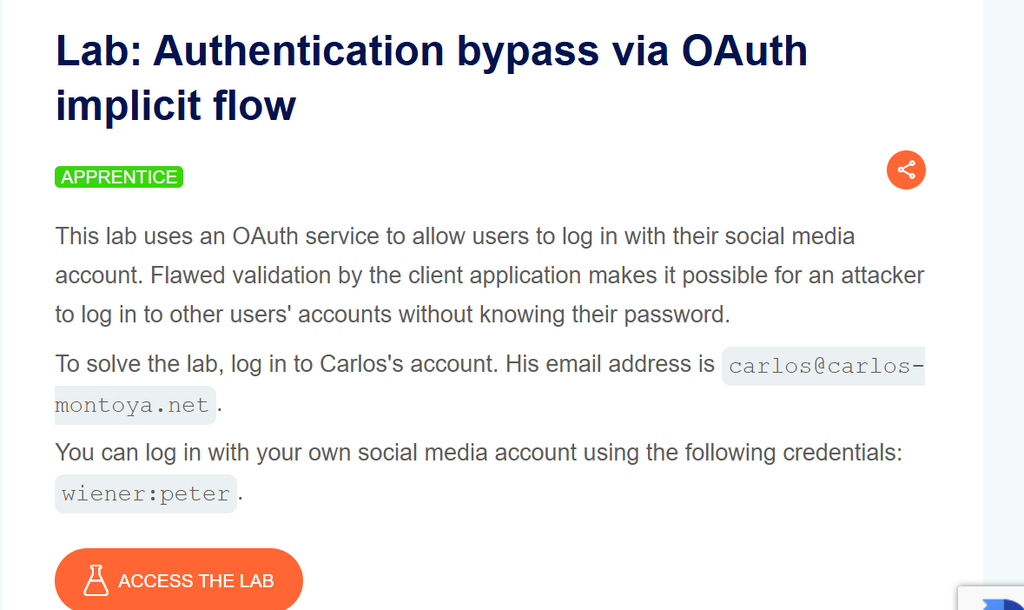
The PortSwigger Web Security Academy OAuth lab, *Authentication bypass via OAuth implicit flow*, demonstrates this exact bug. After logging in, navigate to “All labs,” then open the OAuth authentication category and select the implicit-flow lab.
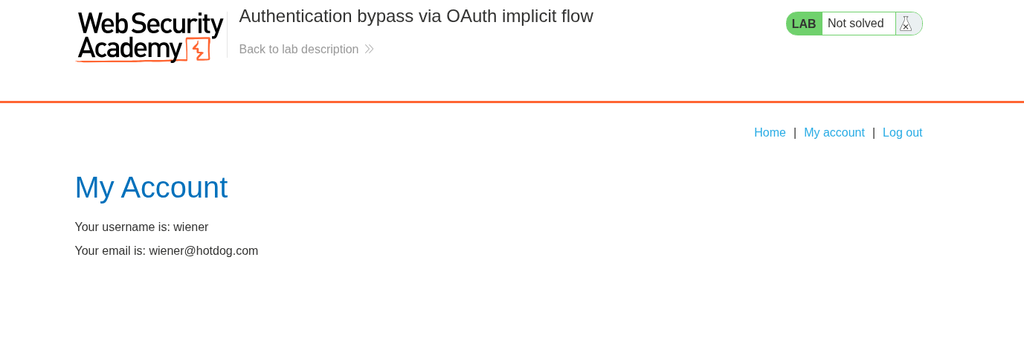
Fire up Burp Suite, intercept traffic, and log in through the OAuth flow via the “My account” page.
In Burp’s HTTP history, study the requests making up the OAuth flow, starting with the authorization request to the /auth endpoint. Note that it carries response_type=token, confirming the implicit grant.
Locate the POST request to the client’s own /authenticate endpoint, which carries the profile information together with the access token, and send it to Repeater.
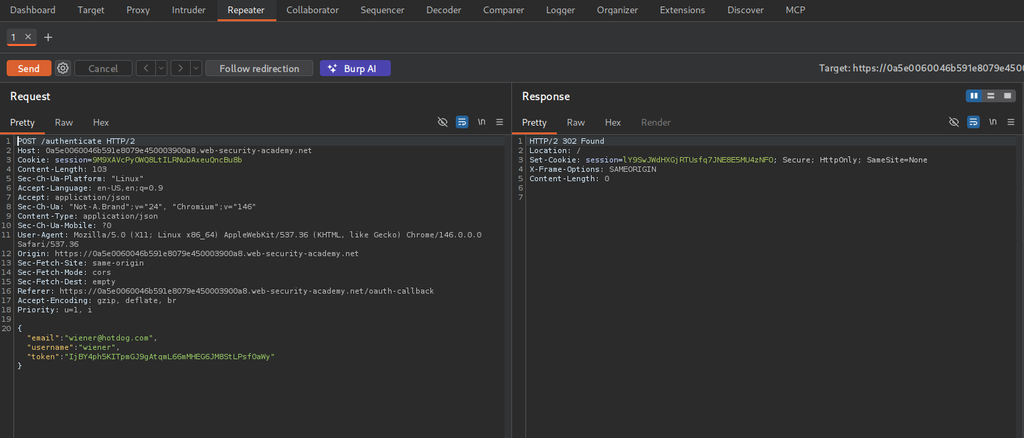
Change the email parameter to a known victim account’s email address, keep the access token as-is, and forward the request.
Reload the account page; if it now shows the victim’s username, the lab is solved, and the bypass is confirmed.
Conclusion
Authentication bypass via OAuth implicit flow comes down to trusting identity data the browser sends instead of verifying it against the token itself. Moving off the deprecated implicit grant, validating tokens server-side against the identity provider, and layering in state, nonce, and PKCE protections closes this gap for good. If you are testing an OAuth integration, start by checking whether the authentication request separates user claims from the token that single design flaw is almost always what makes this bug exploitable.
If you are a cybersecurity enthusiast and interested in CORS. Deep dive into Cross-Origin Resource sharing vulnerabilities with the PortSwigger Lab case study.
FAQ
What is authentication bypass via OAuth implicit flow?
It’s a vulnerability where a client application accepts browser-supplied identity data (like email or username) during OAuth login without verifying it against the access token, letting attackers log in as other users.
Why is the OAuth implicit grant considered insecure?
Because it returns access tokens directly in the browser URL fragment, where they can be exposed to token leakage, replay, and tampering, rather than through a secure back-channel exchange.
How do I test for this vulnerability?
Intercept the OAuth login flow in Burp Suite, find the request that sends profile data and the token to the client’s authentication endpoint, and try swapping the profile fields while keeping a valid token.
What’s the single most effective fix?
Have the client’s back end fetch user identity directly from the identity provider’s /userinfo endpoint using the token, rather than trusting any identity fields sent by the browser.
Does using HTTPS prevent this vulnerability?
No. HTTPS protects data in transit but does nothing to stop an authenticated attacker from editing the contents of their own request before it’s sent.
Should I still use the implicit grant for new projects?
No. Current OAuth 2.0 security guidance recommends the authorization code grant (with PKCE for public clients) instead of the implicit grant for all new implementations.
What tools are best for finding this vulnerability besides Burp Suite?
OWASP ZAP works well as a free alternative for intercepting and replaying OAuth requests.