



Today, the increasing rate of new cyber threats keeps the digital world on its toes, especially AI in cybersecurity. Instead of being defended solely by firewalls, threats are defended against by algorithms, which is the new frontier of digital warfare.
The new cyber defenses do not only require vigilance, but also the intuition that Artificial Intelligence can provide. The pace and volume of cyber threats are increasing at a rate of 38% annually, which, according to Check Point Research, makes the integration of AI into a business framework not an option, but a necessity.
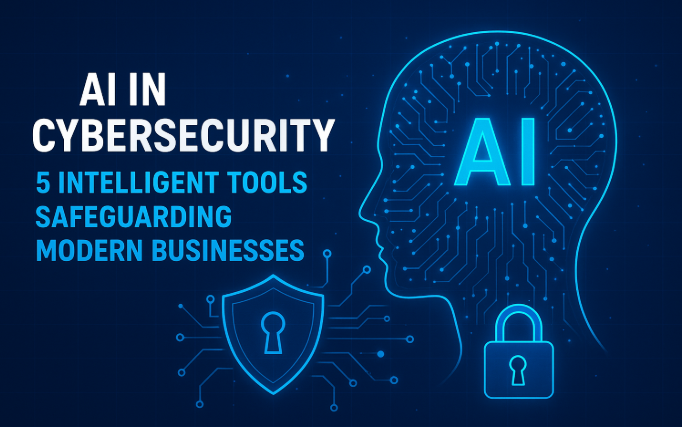
The purpose of this article is to demonstrate the necessity of AI in cyber security, as well as to present five revolutionary AI tools that allow companies to defend, detect, and respond in real time to cyber threats.
Why We Need to Integrate AI in Cybersecurity?
The repetitive tasks such as the monitoring of logs, alerts, network requests, and behavioral records for countless devices, servers, and applications connected to the internet can generate massive amounts of data that can snowball if not properly managed. Cyber threats grow increasingly sophisticated, and in order to respond to that reality, AI must take the lead.
Integrating artificial intelligence in cyber security doesn’t replace human judgment it amplifies it. It gives security analysts context-rich insights, helping them focus on critical alerts instead of wasting hours on false positives. The result is a faster, smarter, and more resilient defense infrastructure capable of withstanding modern threats.
Supercharge Your Cybersecurity With AI
Enhance your existing tools with Cognaisec an AI agent engineered to boost accuracy, speed, and efficiency in threat prevention and security operations.
Top 5 AI Tools Transforming Cybersecurity
The following are top five AI powered cyber security tools listed down below:
Darktrace
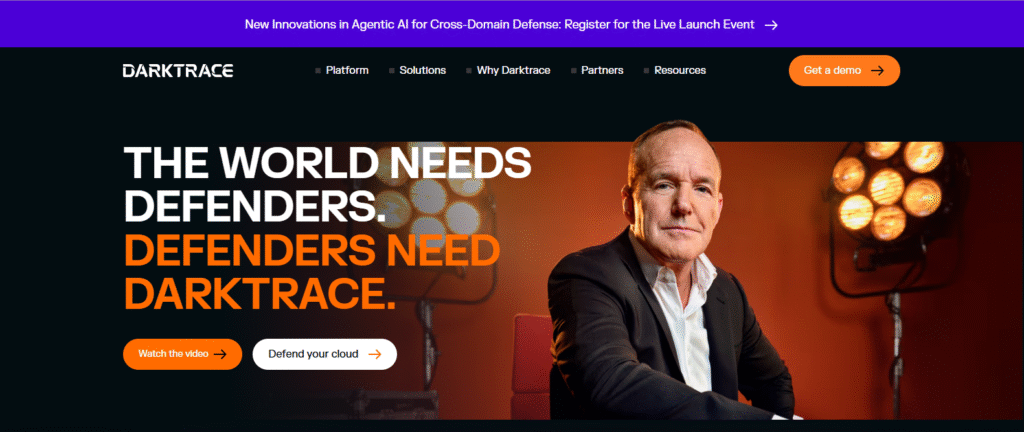
Darktrace has become one of the most recognized names in AI-driven cybersecurity and for good reason. Instead of relying on static threat signatures, Darktrace’s self-learning AI studies the unique “digital DNA” of your organization how users behave, how data flows, and how systems communicate.
This adaptive model means that Darktrace doesn’t need constant updates or predefined rules. It continuously learns, evolves, and adjusts its baseline understanding of your network in real time. Imagine a system that intuitively knows the difference between an employee working late and a compromised account siphoning data.
Key Feature
Darktrace Antigena goes beyond detection; it autonomously responds to active threats, neutralizing suspicious activity before it causes harm. From banking institutions to healthcare networks, organizations worldwide rely on Darktrace to identify and mitigate attacks as they happen, not after the damage is done.
PROS
- Learns and adapts to unique network behaviors without predefined rules.
- Real-time autonomous threat response with minimal human intervention.
- Excellent for detecting insider threats and zero-day attacks.
CONS
- Requires time to train and understand the network baseline.
- High cost may be challenging for small organizations.
CrowdStrike Falcon

CrowdStrike Falcon stands as one of the most advanced cloud-native AI cybersecurity platforms in the world, trusted by global enterprises and government agencies alike. Unlike traditional endpoint protection software that depends heavily on on-premise infrastructure, Falcon operates entirely through the cloud, allowing it to monitor, detect, and stop threats in real time without slowing down system performance.
At its core, Falcon uses machine learning and behavioral analytics to identify suspicious activity across millions of devices simultaneously. It doesn’t just detect malware signatures; it studies how threats behave from unusual file executions to lateral movements within a network.
Key Feature
One of its most notable features is its Threat Graph, which processes trillions of events each day to provide a global perspective on emerging attacks. This means if a ransomware strain appears in one part of the world, Falcon learns from it instantly and protects all connected users globally. It’s a continuous feedback loop of defense AI that evolves as fast as cybercrime itself.
PROS
- Cloud-based architecture ensures scalability and real-time protection.
- Advanced behavioral analytics detect threats before execution.
- Rapid incident response with automated containment.
CONS
- Initial setup requires integration with cloud systems.
- May generate extensive data logs requiring strong IT oversight.
Get 20% off on your first hosting purchase. Provide everything you need to create your website.
SentinelOne Singularity
SentinelOne’s Singularity Platform represents the next generation of endpoint protection one that doesn’t just observe and alert, but acts. Built entirely around autonomous AI, SentinelOne uses machine learning models that monitor every process, file, and script running on a system in real time. When something suspicious occurs, it doesn’t wait for human confirmation it analyzes, decides, and takes action instantly.
Its behavioral AI continuously learns from endpoint activity, identifying deviations that might signal a breach. Once a malicious process is detected, it can automatically kill the process, quarantine files, and even roll back the system to a safe state.
Key Feature
For small and medium-sized businesses especially, SentinelOne serves as a virtual security analyst, working 24/7 to defend endpoints across offices, remote workers, and cloud environments. It’s cybersecurity that doesn’t just react — it heals.
PROS
- Autonomous detection and response minimizes human workload.
- Rollback feature restores affected systems after ransomware attacks.
- Unified console simplifies management across all endpoints.
CONS
- Higher resource consumption during full scans.
- May require tuning to reduce false positives.
IBM QRadar
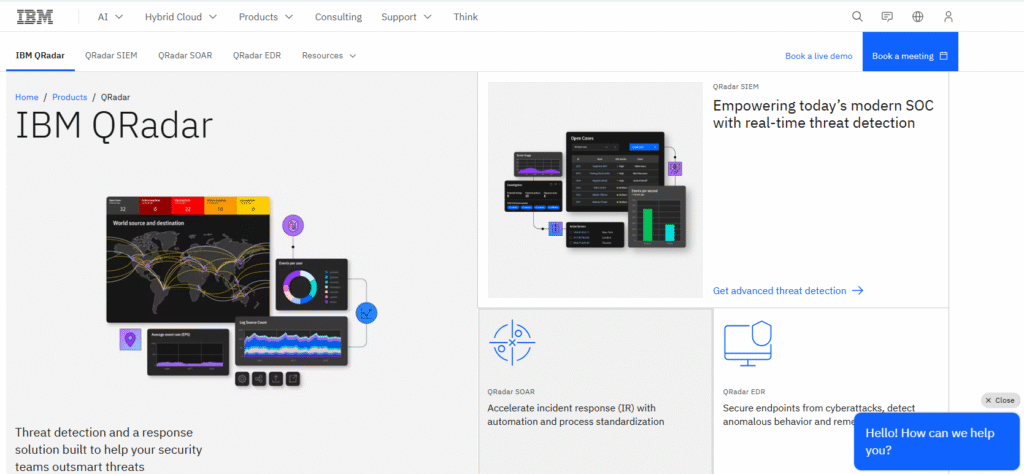
IBM’s QRadar stands as a cornerstone in enterprise cybersecurity a platform that merges artificial intelligence, analytics, and automation to deliver actionable intelligence at scale. Designed for large organizations that handle vast amounts of security data daily.
It strength lies in its intelligence sharing capabilities. It integrates global threat data, regulatory insights, and vulnerability reports to build a broader picture of emerging attacks. Combined with AI-driven anomaly detection, it helps businesses not only spot attacks faster but also understand how and why they occurred.
Key Feature
It functions as a Security Information and Event Management (SIEM) system powered by IBM Watson’s machine learning capabilities. It gathers log data from thousands of devices and applications, then applies AI to detect unusual activity patterns.
PROS
- Advanced AI correlation reduces false positives and alert fatigue.
- Seamless integration with IBM Watson for contextual threat insights.
- Scalable solution ideal for large enterprises with complex infrastructures.
CONS
- Requires dedicated expertise for optimal configuration.
- Licensing and add-ons can significantly raise total cost.
Microsoft Security Copilot
Microsoft’s Security Copilot represents a groundbreaking shift in cybersecurity the fusion of generative AI with enterprise-grade threat defense. Built on OpenAI’s large language models and integrated across Microsoft’s security ecosystem, Security Copilot acts as a real-time assistant for security analysts, helping them detect, investigate, and respond to threats faster and with greater clarity than ever before.
Unlike conventional tools that depend on pre-set dashboards and manual queries, Security Copilot understands natural language input. Analysts can simply ask, “What’s the latest phishing activity in our network?” or “Summarize active threats this week,” and the AI instantly compiles and visualizes actionable insights drawn from Microsoft Defender, Sentinel, and other security data sources.
Key Feature
Security Copilot not only flags threats but also explains why they matter, suggests next steps, and even drafts incident response reports automatically. This democratizes cybersecurity expertise, empowering junior analysts to perform at the level of seasoned professionals. For organizations overwhelmed by alerts and skill shortages, Copilot offers a balance of intelligence and efficiency turning AI into a trusted co-pilot for defense.
PROS
- Uses natural language queries to simplify complex investigations.
- Integrates seamlessly with Microsoft Defender, Sentinel, and 365 tools.
- Accelerates incident response and reporting through automation.
CONS
- Currently limited to Microsoft ecosystem integrations.
- Early adoption phase means evolving feature set.
The AI Advantage: Why Human + Machine Works Best
While AI is revolutionizing cybersecurity, it’s not replacing human expertise it’s amplifying it. The most secure organizations today understand that the true power lies in combining human intuition with machine precision. AI systems can analyze billions of data points, spot patterns invisible to the human eye, and respond to threats in microseconds but they still need human oversight to interpret intent, context, and ethical implications.
Cyberattacks are becoming more adaptive, and so must our defenses. AI-driven tools offer the scale and speed needed to match the pace of evolving threats, but human analysts bring creativity, empathy, and decision-making qualities algorithms can’t replicate. This partnership ensures that while AI handles the noise, humans focus on the signals that matter most.
The future of cybersecurity isn’t man versus machine it’s man with machine. Together, they create a resilient, adaptive, and intelligent defense capable of facing the next generation of digital threats with confidence and precision.
Conclusion
From autonomous detection and real-time incident response to predictive threat modeling, artificial intelligence has reshaped how organizations defend their digital ecosystems. These five AI cybersecurity solutions we explored Darktrace, CrowdStrike Falcon, SentinelOne Singularity, IBM QRadar, and Microsoft Security Copilot, they stand as living proof that machine intelligence can outpace even the most sophisticated cybercriminals.
Getting Cursor AI up and running on Windows and Linux is easier than ever which provides AI-powered coding workflow to build your next big project. Cursor delivers a smooth development experience across platforms.
FAQ
How does AI improve cybersecurity?
AI enhances cybersecurity by detecting threats faster, analyzing vast data sets for anomalies, and automating responses to minimize damage. It helps identify sophisticated attacks that traditional tools often miss.
What are the best AI tools for cybersecurity in 2026?
Top AI cybersecurity tools in 2026 include Darktrace, CrowdStrike Falcon, SentinelOne Singularity, IBM QRadar, and Microsoft Security Copilot each offering unique AI-driven protection and automated response capabilities.
Can AI completely replace human cybersecurity experts?
No. AI complements human analysts by automating detection and response, but human oversight remains essential for interpreting complex threats and making strategic security decisions.
Is AI-based cybersecurity affordable for small businesses?
Yes. While enterprise-grade platforms can be costly, many scalable AI solutions such as SentinelOne and CrowdStrike offer tiered pricing suitable for small and medium-sized businesses.
What is the future of AI in cybersecurity?
The future of AI in cybersecurity lies in adaptive defense systems that learn from every attack. As AI continues to evolve, it will enable faster, more predictive, and collaborative protection across industries.